About Om Jai Jagdish Hare
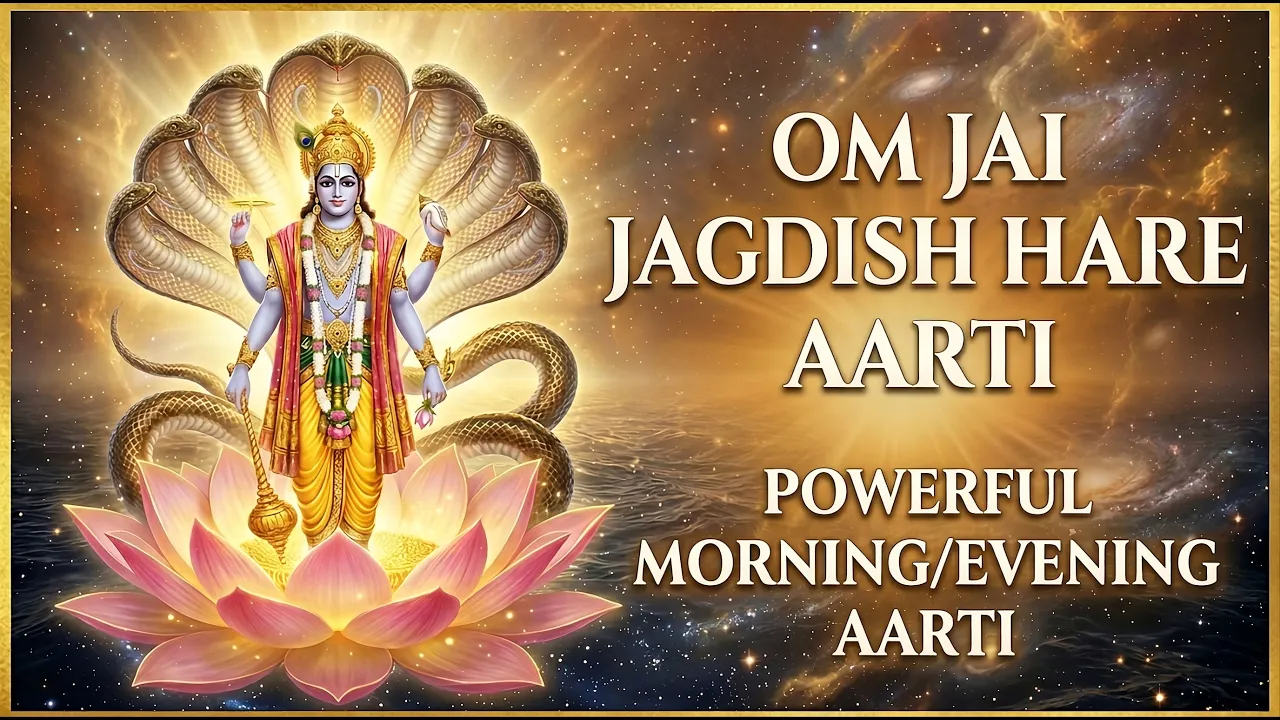
Om Jai Jagdish Hare is one of the most beloved and widely sung aartis in Hinduism, dedicated to Lord Vishnu — Jagdish, the Lord of the Universe. It is believed to have been composed by Pandit Shardha Ram Phillauri around the year 1870. Sung at the conclusion of almost any puja, its gentle words and simple devotion have made it a household aarti across India and among Hindus worldwide. Below you can read the complete aarti in easy Roman-script (English) transliteration, along with its meaning, significance, and the traditional way to perform it.
Om Jai Jagdish Hare — Lyrics in English
Om Jai Jagdish Hare Aarti
Om Jai Jagdish Hare, Swami Jai Jagdish Hare।
Bhakt Jano Ke Sankat, Kshan Mein Door Kare॥
॥ Om Jai Jagdish Hare ॥
Jo Dhyaave Phal Paave, Dukh Bin Se Man Ka।
Sukh Sampati Ghar Aave, Kasht Mite Tan Ka॥
॥ Om Jai Jagdish Hare ॥
Maat Pita Tum Mere, Sharan Gahoon Main Kiski।
Tum Bin Aur Na Dooja, Aas Karoon Jiski॥
॥ Om Jai Jagdish Hare ॥
Tum Pooran Parmatma, Tum Antaryami।
Par Brahma Parmeshwar, Tum Sabke Swami॥
॥ Om Jai Jagdish Hare ॥
Tum Karuna Ke Sagar, Tum Palankarta।
Main Moorakh Khal Kami, Kripa Karo Bharta॥
॥ Om Jai Jagdish Hare ॥
Tum Ho Ek Agochar, Sabke Pranpati।
Kis Vidhi Miloon Dayamay, Tumko Main Kumati॥
॥ Om Jai Jagdish Hare ॥
Deenbandhu Dukhharta, Tum Rakshak Mere।
Apne Haath Uthao, Dwar Pada Tere॥
॥ Om Jai Jagdish Hare ॥
Vishay Vikar Mitao, Paap Haro Deva।
Shraddha Bhakti Badhao, Santan Ki Seva॥
॥ Om Jai Jagdish Hare ॥
Tan, Man, Dhan, Sab Kuch Hai Tera।
Tera Tujhko Arpan, Kya Laage Mera॥
॥ Om Jai Jagdish Hare ॥
Om Jai Jagdish Hare, Swami Jai Jagdish Hare।
Bhakt Jano Ke Sankat, Kshan Mein Door Kare॥
॥ Om Jai Jagdish Hare ॥
Meaning of the Aarti
In this aarti, the devotee praises Lord Vishnu (Jagdish, the Lord of the Universe) as the one who removes the troubles of His devotees in an instant. The verses describe God as the supreme father and mother, the all-knowing protector, the ocean of compassion, and the sustainer of all creation. The devotee surrenders completely, admitting their own faults and asking for grace, devotion, and the service of the saints. The closing verse — “Tera Tujhko Arpan, Kya Laage Mera” (“I offer to You only what is already Yours; nothing is truly mine”) — captures the aarti’s heart: complete devotion and surrender to the divine.
Significance & Benefits
- It is sung at the conclusion of puja for many deities, especially Lord Vishnu and Satyanarayan.
- It is believed to bring peace, prosperity, and the removal of troubles and sorrows.
- It is one of the most widely sung aartis across India and among Hindus worldwide — easy for the whole family to sing together.
🪔 How to Perform the Aarti
- Light a lamp (ghee or camphor) before the image or idol of the deity.
- Hold the lamp in your right hand and rotate it gently clockwise before the deity.
- Sing the aarti with devotion, ideally together with your family.
- At the end, offer the aarti flame to everyone present and distribute the prasad.
Frequently Asked Questions
Who wrote Om Jai Jagdish Hare?
The aarti is believed to have been composed by Pandit Shardha Ram Phillauri around the year 1870.
Which deity is this aarti for?
It is dedicated to Lord Vishnu (Jagdish), but it is traditionally sung at the conclusion of worship for many deities.
When is Om Jai Jagdish Hare sung?
It is usually sung at the end of daily morning or evening puja, or at the conclusion of any kirtan, havan, or satsang.